Showing posts with label Week 3. Show all posts

Sunday, September 11, 2016

Famous Last Words: Job Search

Image result for career fair
Wikimedia: Career Fair
This week I felt like I wrote a better story based off the source stories within Aesop’s fables. I was able to use a style similar to how the fables build up suspense throughout the body before revealing the punchline and ultimately the moral of the story. In addition, I was able to successfully add more dialogue throughout my story this week. Which I thought was able to communicate the personality of characters in the story without just describing it in third person. For the rest of the assignments in this class, I feel I have been staying ahead of the game and on schedule. I haven’t stayed exactly on the schedule I set forth at the beginning, however I haven’t procrastinated to the point where I have missed assignments.

In my other classes things are starting to pick up and I have a couple projects due in the following weeks. Therefore, staying on schedule will be very vital and completing all my assignments on time the next couple weeks. I think my favorite class I have so far is Drilling II. The professor is knowledgeable not only in the classroom but also in the practical application in the real world, which I am a fan of. In addition to classes picking up, I also am on the job hunt since this is my last year. The career fair is this week so I’ll be busy doing last minute edits to my resume and practicing my elevator speech. Times are somewhat tough for my specific major, however I am trying to remain optimistic on the potential unforeseen opportunities. Lastly, I am looking forward to my readings this next week. I believe I am going to read Homer’s Iliad, which I have seen some others from the class have already done. There seems to be some interesting paths for storytelling from it. Thanks for reading!

Friday, September 9, 2016

Review: Emoji Nonsense

Laura Gibbs: Emojis as Hieroglyphics
This was my favorite announcement for reasons that can probably just go unsaid. I guess that's the whole point of emojis, to not have to explain with words, lol. Thanks for reading!

Reading Note's: Aesop's for Children (Winter) Part A

For the extra reading assignment I decided to read the Aesop's for Children however with illustrations by Milo Winter. I thought it would be neat to have an illustration to tie back to my original thoughts on some of these storytelling's. Below are my notes of the reading:

Milo Winter: Farmer and the Stork

  • I like the picture of the tortoise and the two ducks for the reason of its establishes a sense of curiosity for the viewer. Then after reading the tale you realize that curiosity was the demise of the tortoise.
  • The dog, the cock, and the fox is a great classic story where the fox ultimately gets a taste of his own deception. Many of the Aesop's fables are hard to predict the ending. Some times the ending's will be harsh and blunt. Other times the fox will come out the loser in the situation. It is interesting the style and how the build up of the story changes with each type of outcome.
  • The ass and his driver was a very comical picture to me which related perfectly well to how the story ends with the donkey go over the cliff and not listening to reason. Though in a modern sense, the voice of reason is often the hardest to listen to.
  • The farmer and the stork was perhaps my favorite story. Immediately from the illustration I could see it was a story about judgement. And indeed it was and the moral was about the judgement of the company who surrounds you. It reminded me of a interesting saying: "We judge others by their actions, however we judge ourselves by our intentions."
Bibliography: The Aesop for Children, with illustrations by Milo Winter (1919).

Wednesday, September 7, 2016

Wikipedia Trail: From The Wolf and the Crane to John George Bartholomew

Wikipedia: Wolf and the Crane
This week I've started my trail at one of the classic Aesop's fables, The Wolf and the Crane. The wolf promises a reward if the crane helps him from choking to death, the crane does, but then the wolf's reward is he won't eat the crane. I then selected the link to read about Cranes. Mainly just because I wanted to go an animal oriented path. Next I found it interesting that cranes inhabit all but two continents. One being South America and the other Antarctica. Therefore, my next path led to Antarctica. Reading some about Antarctica's history I learned who named it its formal name. That man being cartographer John George Bartholomew. Lastly, I clicked on him because I couldn't remember exactly what else he was famous for then I remembered he was a pioneer for map making and created the first color contour maps.

Learning Challenges: Happiness Jar

Happiness Notes (oulbh)
The learning challenge I would like to bring up this week is Happiness. I thought this was a neat idea and will be my new years resolution for next year. I feel as if myself and humans can always remember the bad things in life but often forget the good things that happen to us everyday. We take it for granted or become complacent in the little things others do for us all the time. Thanks for reading and be happy! 

Growth Mindset: Risky Cats

Cat Taking Risks (Islam Abudaoud)
My growth mindset this week is to not live within the boundaries that we are given, but rather be willing to go outside my comfort zone. To be honest, taking this course is way outside my comfort zone. However, now after three weeks of storytelling and blog posts I have really opened up a side of me that I didn't know existed. This is why we take risks, to discover new talents. Thanks for reading.

Tech Tip: Newsreel Sidebar

I have decided to add a search bar to the footer of my blog in case anyone would like to see if a common keyword occurs in any of my posts. I thought this might be useful for storybooks and seeing if I had written any similar topics as another classmate. Thanks for reading.

The Lone Wolf

One day the wolf was walking down to the river to get a drink of water. When he arrived at the river to get a drink of water, he realized that all of the other animals of the forest were beginning to make their way to the other side of the river away from the wolf. The wolf thought nothing of it and after getting his drink of water from the community river he went back home and went to bed.

The next day the wolf woke up and was thirsty. He again made his way down to the river bank to get himself a drink. After he took his drink of water from the river, he again noticed that all of the other animals of the forest were on the other side of the river far away from him. The wolf began to think to himself that maybe he had a stench or maybe the water on the side of the river where he was drinking was not as good as the other side of the river. The wolf decided to bathe himself in the river and then went back home to go to sleep.
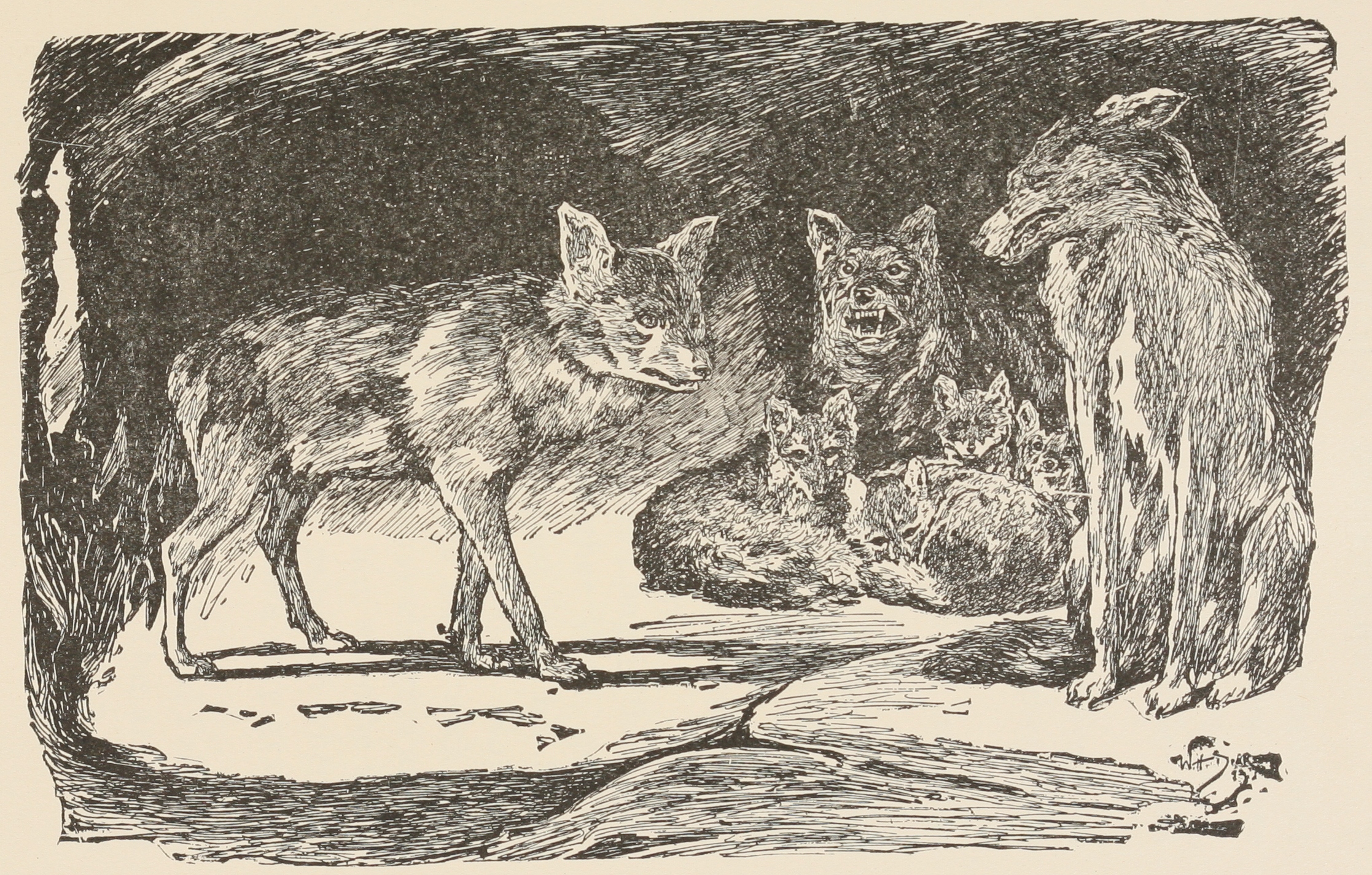

Image result for wolf drinking at river

On the third day, the wolf woke up and was thirsty as usual. He made his way down to his spot on the riverbank where he would normally drink from. This time before taking a drink of water he looked around and noticed again that all the other animals of the forest were on the other side of the river. So, the wolf decided to cross to where the cranes were drinking water and take a drink from there.

Once the wolf had made it to the other side of the river near the cranes, he took a drink of water. After he took his drink of water he noticed all of the other animals of the forest started moving to the spot where he drank the previous days.

Feeling frustrated the wolf cried out to the cranes, “Why will no one drink from the same side of the river as me?”

Once the cranes had crossed the river to the other bank, one yelled back, “Because a wolf cannot be trusted by a crane.”

The wolf, beginning to feel angry, then yelled at the group of goats, “Why will goats not drink from the same side of the river as me?”

One of the goats then yelled back, “Because a wolf cannot be trusted by a goat.”

The wolf, now feeling even angrier about being an outcast, then yelled to the other wolves, “Can a wolf not be trusted by other wolves?”

A moment of silence came over the wolves until the alpha wolf stated, “A wolf who is not trusted by a crane nor a goat cannot be trusted by his own kind.”

The wolf, feeling that he had heard enough, made his way back to his home. He began to eat his sorrows away enjoying his favorite meal of goat and later cleaning his teeth with a crane’s beak.

Author’s Note: This story is inspired from Aesop's Fables. In many of the fables, the wolf is portrayed as the antagonist in the story and I wanted to keep that theme. The specific stories that came to mind were The Wolf and the Crane as well as the Wolf and the Goat. These are both tales where the wolf is either ungrateful or forcefully harmful to another animal of the forest. In addition, I also liked the writing style in the fables where many times there will be a build-up to the punch line. I was able to replicate this by having the wolf revisit the river three days. Ultimately, he finally builds the curiosity and anger to ask the other animals why no one will drink water by him. In doing so, I was able to set up the story so that the other animals gave an indirect answer to his question. This was an element which kept the reader wondering and the wolf as well. Then, in the end, the subtle details of what the wolf does when he arrives back at home alludes to the moral of the story. I wrote the ending of the story to be somewhat ambiguous and give the reader an ending thought on what it might be. Lastly, another element to my story, that I didn’t include last week, was the use of dialogue. Thanks for reading.

Picture courtesy of W.H. Drake: The Two Jungle Books
Bibliography: The Wolf and the Crane, The Wolf and the Goat by Jenny H. Stickney
Tuesday, September 6, 2016

Week 3 Reading Part B: Aesop's Fables

Continued is my reading notes over Aesop's Fables. My goal for part B of this reading is to identify a moral or two to incorporate in a storytelling for this week. Below are my reading notes:

Wikipedia: Wolf and Crane, Wolf and Lamb
  • The story of two pots reminds me of the person who trusts everyone versus someone who trusts no one. This reminds me of the quote that it is equally a crime to trust no man as all men. This intrigues my interest as a possible moral.
  • The story of the oak and the reed is another good fable of how pride and boastfulness is not always the path to success. As the little reed was left standing in the wind storm.
  • The Ax and the trees reminds me of the story of the Wolf and the crane. Its moral shows how kindness can be misrepresented as weakness or foolishness and should be given out upon good judgement. This is definitely a candidate for my next storytelling theme.
  • The eagle and the arrow is a story that portrays a sense of irony to me. It is ironic how the eagle dies from a weapon used from feathers of his kind. This will also be a neat literary element I can include in my story.
  • The nurse and the wolf story was the first story about the wolf which I have seen that the wolf doesn't come out on top. In addition, it seems to be a theme that the wolf is always the portrayed negative character in all of the stories. Another interesting theme to which I could include in my story.
Thanks for reading.

Bibliography:  Aesop's Fables by Stickney

Week 3 Reading Part A: Aesop's Fables

This week I decided to read Aesop's Fables. Below are my reading notes for part A.

  • The story of the wolf and the lamb reminds me of the logic people use to justify their wants even when they know they are wrong.
  • A trend of many of these fables are for the protagonist in the story to do a task three times or more then the punch line of the story comes. This is a characteristic I would like to include in my next story.
  • The story of the Wolf and the crane reminds me of someone who doesn't remain true to their word. In a sense, its the wolf convincing you that we should be thankful for what could've been done to the crane. It's almost an interesting allusion to what happens today in our world.
  • My favorite story is of the little fish and the fisherman as its general moral is that something is always better than nothing. I haven't decided which moral ending my story will have, however I will definitely be consciously trying to reach one when writing this week.
  • The story of the Ox and the frog was a somewhat grim story to me which almost felt as if some people view life as not as important as others. The punch line is also to not try to accomplish what is impossible. 


Bibliography:  Aesop's Fables by Stickney