 |
| Wikipedia: General Stratigraphic column of Bakken |
Showing posts with label Wikipedia. Show all posts
Showing posts with label Wikipedia. Show all posts
Monday, October 10, 2016
Wikipedia Trails: From Sioux to Source Rock
This week I decided to start my trail on the Sioux since that is the native american reading I chose. I learned that many of the Sioux Indians lived in north central united states area like present day North Dakota. Being the Energy focus person I am, I then clicked on the Bakken Formation which is one of the U.S.'s largest oil producing basins. Lastly, I clicked on source rock to fact check Wikipedia's knowledge over hydrocarbon generation. It looked on par to me. Thanks for reading.

Friday, October 7, 2016
Wikipedia Trails: From Celtic Mythology to Copper
Since I read some tales out of Celtic Mythology I decided to begin my trail there. From which I encountered what was called the Iron Age, in which was the era the Celts were from. I then learned that after the Iron Age came the Bronze age in Europe and Asia. This occurred with the advancement of blacksmithing and metal working technology. However, it was also noted that in some areas of the world these ages were flipped in time. Lastly, I learned that bronze was a combination of smelting copper and tin.
 |
| Wikipedia: Native Copper |
Wednesday, October 5, 2016
Wikipedia Trails: From Laos to Tarrifs
This week since I read over the Laos folklore tales I decided to begin my trail on Laos. From there I saw that the country was apart of Asia-Pacific Trade Agreement (APTA). I then learned that this was the oldest preferential trade agreement between any countries within the Asia-Pacific region. I then further learned that this agreement is a means for giving access to participating countries to certain products at reduced tariffs.
 |
| Wikipedia: Storck Harbour Scene |
Sunday, October 2, 2016
Wikipedia Trails: From Brer Rabbit to
I read the African tale of Brer Rabbit so I started there. From which it was natural to learn about hares. I learned that hares do not use burrows for the young , but rather shallow depressions. Lastly, I learned that burrows are a hare or rabbits natural defense against predation. Which is the act of a predator going after prey.
 |
Wikipedia: Hare |
Sunday, September 25, 2016
Wikipedia Trails: From Sinbad the Sailor to Hydrography
Since I read The Voyages of Sinbad this week it felt natural to start out with Sinbad the Sailor, from which took me to the Indian Ocean since that is what he sailed. Then learning history about the Indian Ocean I found myself learning about the International Hydrographic Organization, from which I found myself trying to learn more about Hydrography in general.
 |
| Milo Winter: Sinbad the Sailor |
Sunday, September 18, 2016
Wikipedia Trail: From Arabian Nights to the Sea of Japan
I started out with Arabian Nights because it was the story I read this week. I found out that this series was framed by another group of storytellers which set the setting in Baghdad. Reading some brief history of the city I found out it was almost destroyed in 1258 by the Mongol Empire. I didn't realize how big the mongol empire actually was until I read that it stretched from western Europe to the Sea of Japan. Lastly, I selected this because I felt like I should familiarize myself with geography anytime possible.
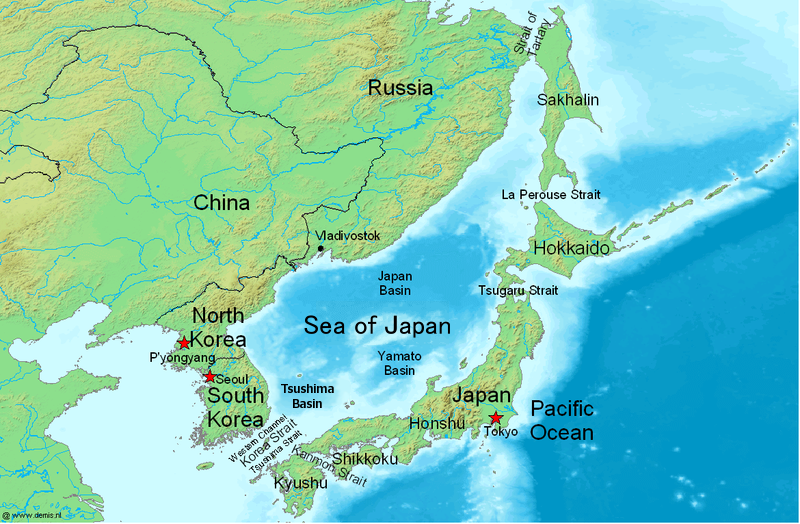 |
| Wikipedia: Sea of Japan |

Wednesday, September 7, 2016
Wikipedia Trail: From The Wolf and the Crane to John George Bartholomew
 |
| Wikipedia: Wolf and the Crane |
Thursday, September 1, 2016
Wikipedia Trail: From Polyphemus to Immortality
The starting point for my trail is the giant cyclops named Polyphemus which appears in ninth book of Homer's Odyssey. I chose this because this was part of the reading I did this week. Odysseus landed on the cyclops' island when traveling home from the Trojan War, therefore that was my next trail. This interested me to research and learn more about the war that Odysseus was coming from. The war essentially was over the golden apple to which Zeus presented before the fairest women. Therefore, my next link was the golden apple. The last thing I led to was immortality because this is what the golden apple ultimately grants and stands for.
 |
| Wikipedia: Polyphemus |
Sunday, August 28, 2016
Wikipedia Trail: From Homer's Odyssey to Napoleon Bonaparte
Since I plan on reading Homer's Odyssey this upcoming week I decided to start my trail here. I then began looking at where geographically did this myth take place and I stumbled upon the Ionian Islands. These are the islands just off the west coast of Greece which Odysseus will travel. Then I started to look into the history of the Islands and actually stumbled across the Treaty of Paris. Which in this case stated that these islands were now under British territory in 1815. I found this interesting just for the simple fact that I remember talking about the Treaty of Paris in history class as a high school student. The last link I stumbled upon was Napoleon Bonaparte. This was connected due to he was defeated in 1815 and ultimately was the reason for the signing of the treaty.
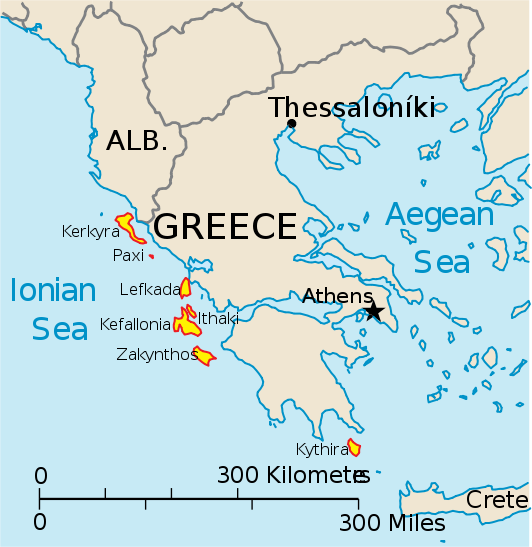 |
| Wikipedia: Ionian Islands |

Subscribe to:
Posts (Atom)