Showing posts with label Portfolio. Show all posts

Sunday, October 2, 2016

Portfolio Introduction

The Lone Wolf
A naive wolf cannot figure out why he has no friends
Image result for wolf drinking at river
W.H. Drake: The Two Jungle Books
Sinbad's Journey
Sinbad presses his luck and ends up where he started
A dad tells his son a story through the changing of story characters
Image result for father son fishing
Wikimedia: Father son Fishing

Wednesday, September 21, 2016

Story: Sinbad's Journey

Sinbad began life as a poor merchant along the coast. Every day he watched as the great wooden vessels came in and out of port. He dreamt that one day he would be fortunate enough to buy his own vessel so that he could sail the seas and trade goods to foreign countries. One day, as he was watching from his cart of fruit along the coast, he saw a giant bird’s egg on the shore. Sinbad, being the curious fellow he was, went to investigate. As he looked upon it, it glimmered in the sunshine like a great pearl. Then Sinbad thought of an idea. He knew that this was no ordinary egg and began to fantasize of the great fortune it might bring him. So Sinbad dumped out his cart of fruit and secured the egg in it. As he was dragging it off the shore, he saw a great shadow in the sand with wings spread very wide. He immediately knew that this had to be the mother bird and began running faster with his cart to his home. Before the bird could cause any harm to Sinbad he made it inside safely with the egg. He waited a few hours before leaving his home and decided to attempt to sell the egg while the bird was away. Upon seeing one of the wealthy vessel owners in the market, Sinbad struck a deal to trade the magnificent egg for his ship and crew.

The next morning Sinbad set sail with his crew on the open seas. Sinbad stood upon the bow of the ship soaking in the fresh air and great view of the open ocean. As he stood there he thought to himself of the great change in circumstances he had gone through in just 24 hours.

Sinbad and his crew sailed for six days and six nights without seeing another ship or land. They were seemingly lost, for they intended to set sail for the west Indies. Then a member of his crew in the crow’s nest lookout saw an island in the distance. As they approached the island it looked barren and uninviting. Sinbad and his crew landed on shore the island and began to cautiously explore. One member of the crew spotted a giant bird’s egg on the beach. Sinbad, in disbelief, saw the egg and immediately began to think of the riches it could bring him again. He ordered his crew to load the egg on ship. Once his crew had gotten the egg aboard the vessel, Sinbad began to set sails back to the port.

Suddenly, there was a piercing screeching noise coming from the island. A shadow soon came over the boat that was three times the shadow of the previous bird that Sinbad had narrowly escaped. The angry bird was carrying a giant boulder with its talons. It let it loose above the vessel and exploded Sinbad’s ship into thousands of splinters. Sinbad luckily grasped onto a piece of the wreckage and floated at sea for two days. On the third day a ship heading to Sinbad’s home port picked him up and took him home.

The next morning Sinbad was back to selling fruit out of his cart and thinking about what could have been.

The Voyage: (Roc, by E. J. Detmold)

Author’s Note: The story was inspired from the Voyages of Sinbad. There are a few elements I wanted to change from the source story and there are some elements that I wanted to keep. For one I wanted to give a reason for Sinbad’s misfortune at the end of the story. It seemed as if in the source story he was lucky or unlucky sometimes, but for no reasonable explanation. In the source story, the bird is originally angry with Sinbad and his crew for eating the roc egg, before crushing his vessel. I wanted to add the spin of theft of the second roc egg instead of his crew eating it to explain why the roc was angry with Sinbad and his crew. In addition, I wanted to add the theme of rags to riches and back to rags. I feel that the story really stresses the impact of greed versus the original story is more of ambition and luck themed. Taking the second egg off the island proved to be too greedy. Sinbad is still his lucky self and ends up surviving this voyage and returning home though. In addition, I included the giant bird which wrecks Sinbad’s vessel, but I felt that my source for the bird’s anger and dash of karma gave the story some new perspective. Lastly, at the end of the story I think Sinbad asks himself if he would do it any different if given another chance. In my opinion, he probably regrets taking the second egg. Thanks for reading and I look forward to your comments!

Bibliography: The Arabian Nights' Entertainments by Andrew Lang and illustrated by H. J. Ford (1898).

Wednesday, September 14, 2016

Story: The Levels of Storytelling

A man and his son went down to the river dock to go fishing. They cast their lines out as far as they could and then set up their lawn chairs. As five minutes passed the boy grew impatient with the inactivity of his fishing pole so he asked his father, “Dad, can I have a soda pop out of the ice chest?”

The father replied, “Yes, of course.” The boy anxiously popped open his soda can and drank it until it was all gone. Another five minutes passed and the boy grew impatient again.

This time he asked his father, “Dad, will you tell me a story until the fish wake up to bite?”

~~~~~~
The father nodded and said, “I will tell you the story of the wolf and the crane. One day the wolf who was king of the woods was struggling. The wolf, needing help, saw a crane crossing the river.

He quickly cried out, “Please help me! I’m choking on a bone!”

The crane responded, “I cannot help you because all wolves are ungrateful.”

The wolf, feeling confused, replied, “How can you not trust me if we have never met before?”

The crane responded, “I will tell you the story of the wolf and the lamb and this will explain why you cannot be trusted.

~~~~~~
There once was a lamb drinking water from the same stream as one of your brother wolves. As the lamb took water from the stream the wolf howled out, “How dare you muddy the water I drink from!”

The lamb replied, “I meant no harm and I will be on my way.”

The wolf, stepping in front of the lamb’s path, said, “Not so fast. You have talked badly of me before.” Before the lamb could reply the wolf ate the poor lamb up.”

The crane then said, “See, this is why a wolf cannot be trusted. How will I know you will not do the same after I help you?”

 The wolf, desperately needing help, replied, “I will give you a gift if you help me in my time of need.” The crane decided to help the wolf and freed him from the bone he was choking on. Once relieved the wolf replied, “My gift for you helping me is that I will not eat you today.” The crane feeling angr… The boy interrupted, “Why would the wolf do that when he said he was going to give him a gift? And why did he still do it after the crane told the choking wolf the story of the wolf and the lamb?” The father replied, “Well you see, not all wolves can be trusted even if they say they can. In this case the wolf was a liar but maybe the next one will be true to his word. The moral of the story is th..”

The boy scrambled for his fishing pole as it slid across the dock. He grasped the end before letting it slip into the water and shouted, “Dad! Come help me reel this big fish in!” After the father and son had reeled the giant fish in the boy said, “Dad, tell me the story of how fish get so big.”
Image result for father son fishing
Wikimedia: Father son Fishing

Author’s note: This story is inspired by a couple stories. The style of the story comes from The Arabian Nights' Entertainments. The way the story develops with another level of storytelling is the idea I was chasing. The character who tells the story each time also changes, therefore giving that perception of a new dimension of storytelling. In the story of Scheherazade from The Arabian Nights’ I liked the style in which it was told, but I was not a fan of the grimness of it. Therefore, I changed it to more of a children’s style and included some elements from Aesop’s Fables. In addition, this story differs from my previous in the fact that this entire story is almost all dialogue. I felt like I was able to capture better traits of each character’s personality through the levels of storytelling by the use of dialogue. Lastly, since the story is fairly off topic from the source I included the boy asking his father to tell him another story at the end. I felt this element is similar to how in the story of Scheherazade she is able to transition from levels of storytelling and back while keeping Sultan intrigued. Thanks for reading!
Bibliography: The Fables of Aesop by Joseph Jacobs (1894).  
The Arabian Nights' Entertainments by Andrew Lang and illustrated by H. J. Ford (1898).

Wednesday, September 7, 2016

The Lone Wolf

One day the wolf was walking down to the river to get a drink of water. When he arrived at the river to get a drink of water, he realized that all of the other animals of the forest were beginning to make their way to the other side of the river away from the wolf. The wolf thought nothing of it and after getting his drink of water from the community river he went back home and went to bed.

The next day the wolf woke up and was thirsty. He again made his way down to the river bank to get himself a drink. After he took his drink of water from the river, he again noticed that all of the other animals of the forest were on the other side of the river far away from him. The wolf began to think to himself that maybe he had a stench or maybe the water on the side of the river where he was drinking was not as good as the other side of the river. The wolf decided to bathe himself in the river and then went back home to go to sleep.


Image result for wolf drinking at river

On the third day, the wolf woke up and was thirsty as usual. He made his way down to his spot on the riverbank where he would normally drink from. This time before taking a drink of water he looked around and noticed again that all the other animals of the forest were on the other side of the river. So, the wolf decided to cross to where the cranes were drinking water and take a drink from there.

Once the wolf had made it to the other side of the river near the cranes, he took a drink of water. After he took his drink of water he noticed all of the other animals of the forest started moving to the spot where he drank the previous days.

Feeling frustrated the wolf cried out to the cranes, “Why will no one drink from the same side of the river as me?”

Once the cranes had crossed the river to the other bank, one yelled back, “Because a wolf cannot be trusted by a crane.”

The wolf, beginning to feel angry, then yelled at the group of goats, “Why will goats not drink from the same side of the river as me?”

One of the goats then yelled back, “Because a wolf cannot be trusted by a goat.”

The wolf, now feeling even angrier about being an outcast, then yelled to the other wolves, “Can a wolf not be trusted by other wolves?”

A moment of silence came over the wolves until the alpha wolf stated, “A wolf who is not trusted by a crane nor a goat cannot be trusted by his own kind.”

The wolf, feeling that he had heard enough, made his way back to his home. He began to eat his sorrows away enjoying his favorite meal of goat and later cleaning his teeth with a crane’s beak.

Author’s Note: This story is inspired from Aesop's Fables. In many of the fables, the wolf is portrayed as the antagonist in the story and I wanted to keep that theme. The specific stories that came to mind were The Wolf and the Crane as well as the Wolf and the Goat. These are both tales where the wolf is either ungrateful or forcefully harmful to another animal of the forest. In addition, I also liked the writing style in the fables where many times there will be a build-up to the punch line. I was able to replicate this by having the wolf revisit the river three days. Ultimately, he finally builds the curiosity and anger to ask the other animals why no one will drink water by him. In doing so, I was able to set up the story so that the other animals gave an indirect answer to his question. This was an element which kept the reader wondering and the wolf as well. Then, in the end, the subtle details of what the wolf does when he arrives back at home alludes to the moral of the story. I wrote the ending of the story to be somewhat ambiguous and give the reader an ending thought on what it might be. Lastly, another element to my story, that I didn’t include last week, was the use of dialogue. Thanks for reading.

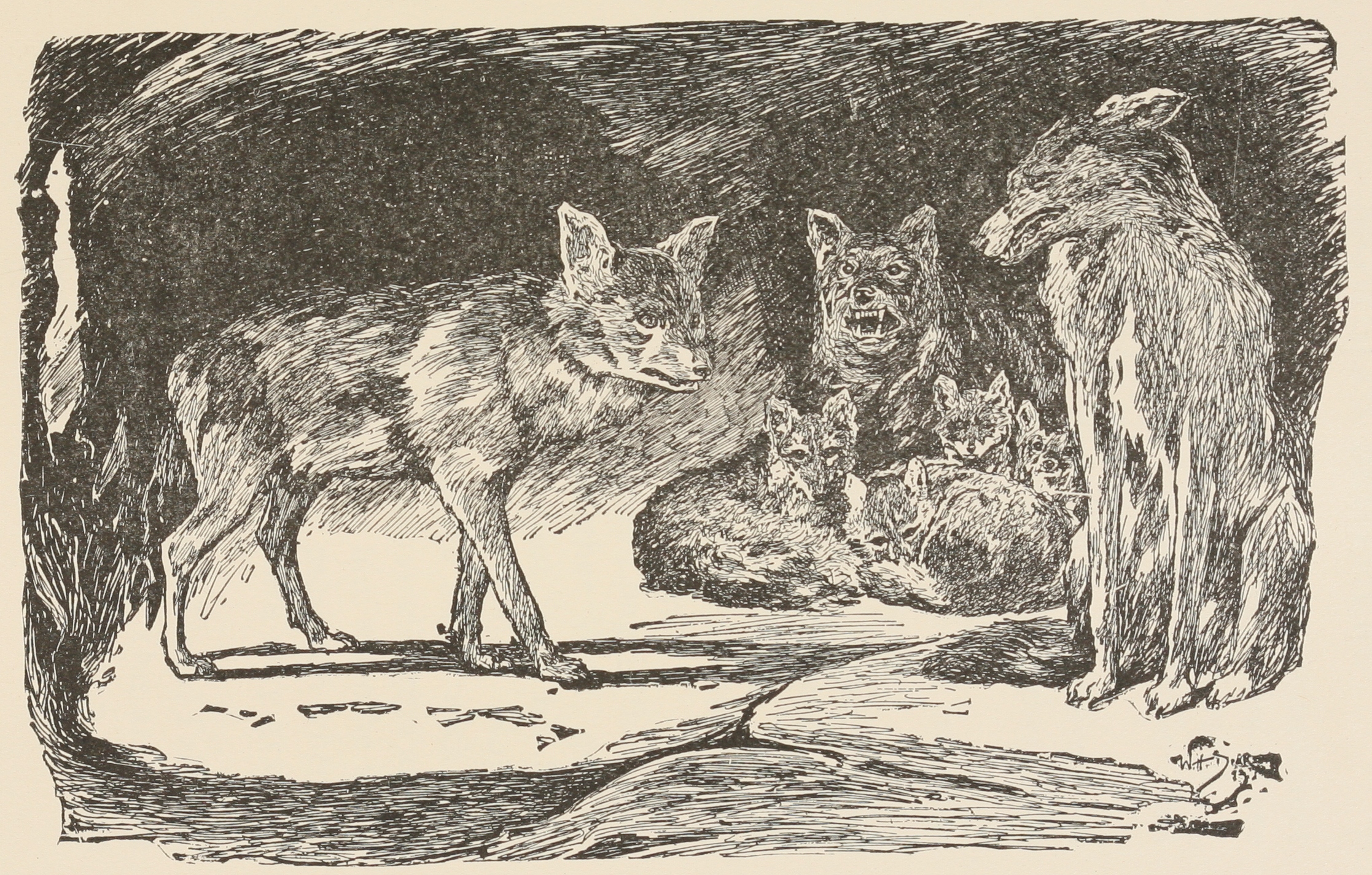
Picture courtesy of W.H. Drake: The Two Jungle Books
Bibliography: The Wolf and the Crane, The Wolf and the Goat by Jenny H. Stickney